Blog top > Articles from March 2026 > Where Did Rondo Form Come From?
This is a blog about this site, which introduces the lesser-known Emanuel Bach (C. P. E. Bach). This English version was translated from Japanese one by ChatGPT.
Where Did Rondo Form Come From?
How the Concerto Entered the Keyboard
I will also reproduce here what I originally posted as a Medium article. It focuses on C. P. E. Bach’s contribution to the formation of rondo form.
When listening to Mozart or Beethoven, one often encounters the term rondo form. It is usually explained simply: a form in which the main theme keeps coming back.
A typical pattern looks like this:
A–B–A–C–A
The initial theme, A, returns repeatedly, separated by contrasting sections.
This structure feels natural and reassuring. As listeners, we pass through unfamiliar territory, only to find ourselves returning to something we recognize. It feels like traveling far away and eventually coming home.
But this raises two deeper questions.
Where did this structure come from?
And why does the theme return at all?
The Principle of Rondo Already Existed Inside the Concerto
To understand the origin of rondo form, we must look not at solo keyboard music, but at the Baroque concerto.
In the Baroque concertos of Vivaldi and J. S. Bach, particularly in the concerto grosso, we find a structure known
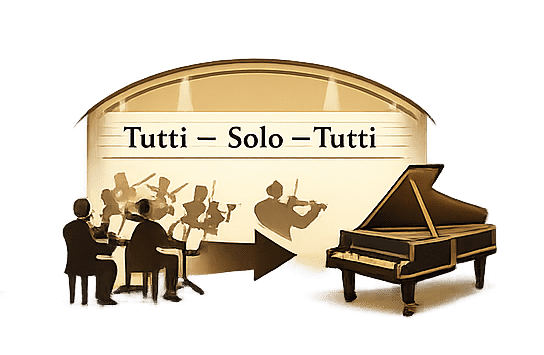
as ritornello form. In this form, the full ensemble — the tutti — presents a main theme.
This alternates with passages for solo instrument:
Tutti — Solo — Tutti — Solo — Tutti
The tutti introduces the theme. The solo sections depart from it, explore new musical territory,
and eventually the tutti returns.
Structurally, this is equivalent to:
A–B–A–C–A
In other words, the fundamental principle of rondo form already existed inside the concerto grosso. But in the concerto, the return of the theme appears as a change of performers. The theme returns because the full ensemble comes back.
For rondo form to emerge as an independent form, this contrast had to be internalized within a single instrument.
The Turning Point: Carl Philipp Emanuel Bach
This transformation was accomplished by Carl Philipp Emanuel Bach, the son of J. S. Bach. Working in the mid-18th century, C. P. E. Bach was one of the most innovative keyboard composers of his time. In his music, the structural logic of the concerto was transferred into solo keyboard works.
On a keyboard instrument, the two hands can assume different roles. The left hand may provide stability, while the right hand moves freely. One hand may present the theme, while the other responds or departs from it.
In this way, the dialogue between tutti and solo — previously realized by different instrumental groups — was recreated within a single keyboard instrument.
What had been an external contrast between groups became an internal contrast within musical structure itself. For the first time, the architecture of the concerto was absorbed into a keyboard instrument.
Return Is Not Mere Repetition
In C. P. E. Bach’s keyboard works, themes do not simply repeat. They return after a journey. Sometimes they are shortened. Sometimes ornamented. Sometimes subtly transformed. The theme remains recognizable, yet it is not exactly the same.
This return is not merely structural. It is experiential. The music moves into instability, uncertainty, and change — and then returns to stability.
Rondo form crystallizes this process into a formal principle.
The Classical Era Perfected the Form
After C. P. E. Bach, the form continued to evolve, and composers such as Haydn and Mozart refined and stabilized it.
Rondo form became one of the central formal designs of the Classical era, especially in the final movements of sonatas, symphonies, and concertos. What had originated as a dialogue between ensemble and soloist was now fully integrated into solo musical structure. The concerto had, in a sense, entered the keyboard.
Why Does the Theme Return?
The returning theme is not merely a formal requirement. It serves a deeper function.
Music unfolds through time. It constantly changes. Yet it also seeks coherence — a sense of identity that persists through change.
Rondo form resolves this tension. It allows music to move forward without losing itself. It embodies both change and continuity.
Rondo Form as the Memory of the Concerto
Rondo form is not simply a keyboard form. It is the internalization of a concerto principle. The contrast between tutti and solo became a contrast between musical states within a single instrument. What was once external became internal.
Rondo form is, in this sense, the memory of the concerto.
And it was in the works of Carl Philipp Emanuel Bach that this transformation first fully occurred.
Listening Again
When we listen to Mozart or Beethoven, we are not hearing rondo form in isolation. We are hearing the echo of an earlier musical world — the concerto grosso — now transformed and internalized within a single instrument. Each return of the theme carries that history within itself.
Rondo form is not merely repetition. It is music finding its way back to itself.